
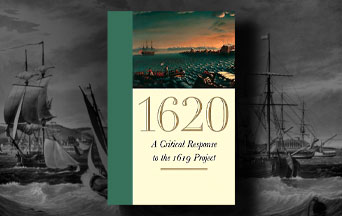
If future American historians look for a perfect symbol of the academic madness of the present times, they will point to The 1619 Project. It springs from an educational establishment that has abandoned truth and objectivity. Mainstream media and its culture have embraced the project’s art of propaganda. Some liberal state departments of education, local school boards, and classroom teachers adopted it before the ink on its pages was dry.
The 1619 Project is a compendium of leftist attitudes about the United States.
If those same historians would want to document that the entire academic world circa 2020 did not lose its head, they can start with 1620: A Critical Response to the 1619 Project by Peter W. Wood. By that time in the future, the historians will know which point of view prevailed. If hope and not hate won the day, it will be because of denunciations like Dr. Wood’s fine book.
An Important Task, Well Done
1620 accomplishes one essential task. It examines The 1619 Project and separates its lies and half-truths from its pseudo-academic veneer.
Peter W. Wood is the president of the National Association of Scholars. Founded in 1987, NAS promotes the idea that higher education is still a search for objective truth. In 1996, they published The Dissolution of General Education 1914-1993, which documented the decline of the American university. In 2013, NAS published Dr. Wood’s Recasting History: Are Race, Class, and Gender Dominating American History? The NAS also champions the Western Civilization courses that virtually all universities required until the late seventies—and are so vilified by leftist academics today.
Greatness Gained Through Submission
The difference between the NAS’s earlier works and 1620 is that this new book while maintaining high academic standards, is written for a wider audience. It explains the problems of 1619 but does not lapse into the academic jargon that many readers find perplexing. The following example is an illustration:
“If The 1619 Project were a term paper, any knowledgeable, fair-minded teacher would give it an F and be done with it. It demonstrates not only incompetence in handling basic facts, but also a total disregard for the importance of using reliable sources. The author of the term paper displays wild overconfidence in her opinions and rushes past points that she should have and easily could have checked.”
Dr. Woods laments that The 1619 Project is not an incompetent term paper but a major statement of the prestigious New York Times. From this platform, the program is doing incalculable damage to the teaching of U.S. history in the nation’s schools.
Lies, Half-Truths, and Inconsistencies
Among the author’s many points about The 1619 Project are five major errors listed below.
1. 1619 removes American slavery from any context. It never acknowledges that slavery existed (and continues to exist) in other cultures, places and eras. For instance, it never mentions that slavery existed in the Americas long before any Europeans arrived. It does not point out that most Africans were initially enslaved by other Africans and then sold to European slave traders.
 Learn All About the Prophecies of Our Lady of Good Success About Our Times
2. It promotes understandings of slavery in America that are factually false. For example, project author Nikole Hannah-Jones writes of the first Africans sold in Jamestown in 1619. “They were among the 12.5 million who would be kidnapped from their homes and brought in chains across the Atlantic Ocean….” Such a statement leads a student to think that all 12.5 million slaves came to the U.S. or the 13 colonies over time. That is false. Dr. Wood accepts the 12.5 million number as a total but points out that only 388,000 came to North America. That is only slightly more than three percent of the total. A far larger number went to the “sugar colonies” of the Caribbean.
3. Nikole Hannah-Jones would have students believe that enslaving Africans was eagerly and enthusiastically accepted by the earliest Jamestown settlers. Dr. Wood points out that slavery came as something of a surprise, as witnessed by the fact that no legal status for slaves existed in Virginia in 1619. These early Africans were treated as “indentured servants,” for which there was a pre-existing legal structure. African slavery in Virginia took almost a century to become the institution that most students would recognize.
4. The 1619 Project resists the fact that much heavy lifting in the process of abolishing slavery was done by white men. The politics of abolition—and the white politicians who debated it—go unmentioned. In Nikole Hannah-Jones’s fantasy world, the abolition of slavery was accomplished by the enslaved—and only the enslaved.
Eternal and Natural Law: The Foundation of Morals and Law
5. The motivation behind 1619 is that the history of American slavery has been underplayed or ignored. Dr. Wood spends a fair amount of time showing that this contention was, perhaps, accurate until the fifties. However, the history of slavery has been intensively studied and taught in the last seven decades. No American history textbook in common use in 2020 can be justly accused of ignoring slavery.
The Impact of Bad Ideas
These are a few of the inconsistencies, misleading assumptions, and falsehoods presented by The 1619 Project. Dr. Wood’s fine book offers more than enough evidence to back up his conclusions. “The 1619 Project as a whole is myth-making aimed at intensifying identity politics and group grievance. It doesn’t aim, as it says, to tell ‘our story truthfully.’ It aims to tell it with falsehoods and deceptions for the purpose of instilling resentment.”
Unfortunately, these “falsehoods and deceptions” are making their way into the curricula of far too many schools. They form the undercurrent of animosity and resentment found in many American history classrooms.
Nikole Hannah-Jones and 1619 are not the problem. The New York Times is not the problem. The problem is that too many American progressives see history classrooms as incubators of “social justice.” Teachers, buttressed by 1619 and texts such as A People’s History of the United States, present a persuasive version of Critical Race Theory to children unequipped to refute it. Left-leaning instructors use their students to “signal their virtue” as “allies” of the Black Lives Matter and other such movements.
Science Confirms: Angels Took the House of Our Lady of Nazareth to Loreto
The future of America may depend on defeating these corrosive ideas.
Intellectual Ammunition
Unfortunately, most parents who find themselves in verbal battles with teachers, administrators and school boards are unprepared. They, unlike their adversaries, haven’t studied history in decades. They have not participated in “professional development sessions” in which the ironically racist ideas of Ibram X. Kendi’s How to be an Anti-Racist are promoted.
In this context, 1620: A Critical Response to the 1619 Project is a vital resource. It supplies much-needed ammunition for those ideological battles. With it, parents (and other concerned Americans) can poke holes in 1619 and Critical Race Theory.
Everyone needs to engage in this battle as if America’s children’s futures depend on it—because they do.
Photo Credit: © Mannaggia — stock.adobe.com